
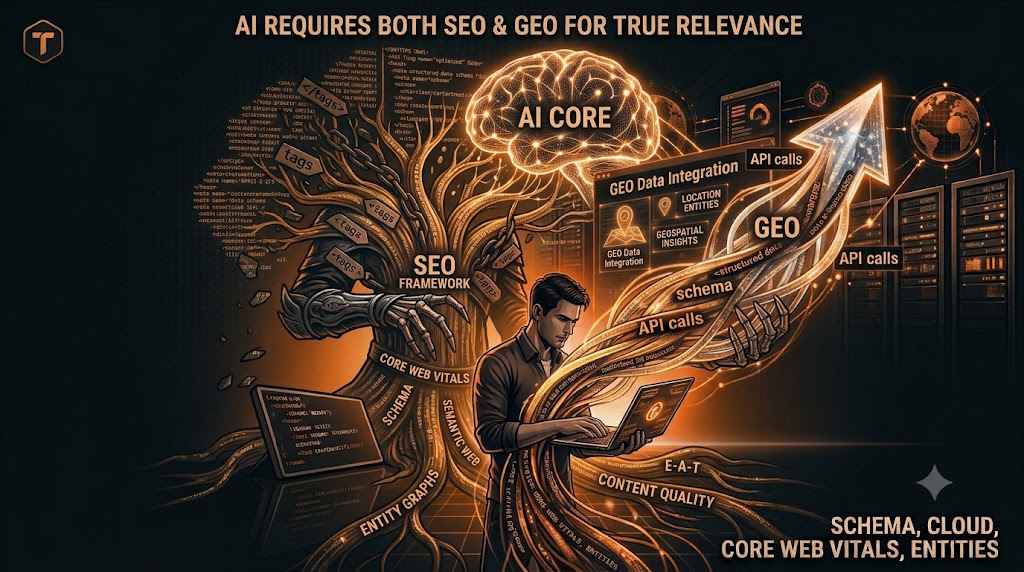
GEO Killed SEO.
SEO was already enough of a swamp of self-proclaimed specialists, experts, gurus, strategists, consultants, and whatever other title people have invented for themselves this week. Now we have GEO.
And apparently, according to a growing number of articles, LinkedIn posts, marketing agencies, and “AI search experts,” GEO is going to kill SEO.
SEO is dying. Search engines are changing. AI is taking over. And apparently, we all need to forget everything we knew about SEO and start optimizing exclusively for AI.
Before you start railing me with: “That’s exactly what you’re doing. You’re just another person claiming to be an expert.” Fair enough.
But let’s put the marketing bullshit aside for a moment and look at the technology.
Because the claim I’m challenging isn’t that GEO exists. It absolutely does. The claim is that GEO is replacing SEO.
And that’s where my BS meter starts going nuts.
So, What Exactly Is GEO?
So, What Exactly Is GEO?Let’s strip away the acronym soup for a moment.
GEO stands for Generative Engine Optimization.
The basic idea is that instead of only optimizing your website to appear in traditional search results, you also want your content to be understood, retrieved, referenced, and potentially cited by generative AI systems.
Instead of only asking, “How do I rank for this keyword?” you’re increasingly asking, “How do I make sure an AI system recognizes my website as a useful and trustworthy source when someone asks a relevant question?”
That’s a legitimate question.
The way people search for information is changing. Someone might type “Best web developer in Taipei” into Google. Or they might ask an AI, “I’m a business owner in Taipei. I need someone to rebuild my website, improve its technical SEO, and help me grow my online visibility. Who should I talk to?”
Those are two very different search experiences.
The second isn’t necessarily looking for a page that contains the exact keyword “best web developer in Taipei.” It’s looking for context.
It needs to understand who you are, what you do, where you operate, what you specialize in, whether you’re credible, and whether your website actually supports those claims.
That’s where GEO becomes interesting.
But here’s the part that gets conveniently left out of a lot of GEO marketing:
The AI still needs to find and understand the information in the first place.
GEO Still Needs SEO
This is where the “SEO is dead” argument starts to fall apart.
AI systems don’t have some magical connection to every website on the internet. They don’t automatically know what your business does. They don’t automatically know that your website exists. And they certainly don’t automatically trust everything you publish.
Information has to come from somewhere.
For Google’s own AI search features, the process is particularly interesting. Google’s AI search experiences still rely on its core Search systems. That means the fundamental process of discovering, crawling, indexing, and understanding information hasn’t suddenly disappeared because an AI is now sitting between you and the search results.
In other words, before an AI system can decide whether your content is useful enough to reference, your content still needs to be discoverable, accessible, crawlable, indexable, and understandable.
You still need:
- A technically accessible website
- Proper crawling and indexing
- A logical site architecture
- Well-structured content
- Descriptive titles and headings
- Internal linking
- Relevant context and entities
- Reliable and useful information
- Authority and credibility
- Content that actually answers questions
In other words…
SEO + GEO Instead of SEO vs. GEO
SEO makes your information discoverable, accessible, crawlable, indexable, and understandable.GEO builds on that by focusing on how your information is interpreted and surfaced within generative search experiences.
The two aren’t competing strategies. They work together.
And here’s the funny part: a lot of what is now being sold as “GEO best practices” sounds suspiciously familiar.
Write clear content. Answer questions directly. Build topical authority. Demonstrate real expertise. Structure your website properly. Create useful information. Build trust.
Wait a minute…
Isn’t that what we were supposed to be doing with SEO already?
Yes, GEO brings new considerations. AI can interpret language differently, combine information from multiple sources, and generate answers instead of simply displaying a list of links.
That’s a real change.
But it doesn’t erase the fundamentals.
A technically sound website with useful content, clear structure, genuine expertise, and a credible technical-seo" class="vx-autolink">digital footprint is still going to be better positioned for search — whether the person searching finds you through Google or an AI-generated answer.
GEO isn’t replacing SEO. It’s expanding the way we think about search.
