

I launched my website three days ago.
Three days.
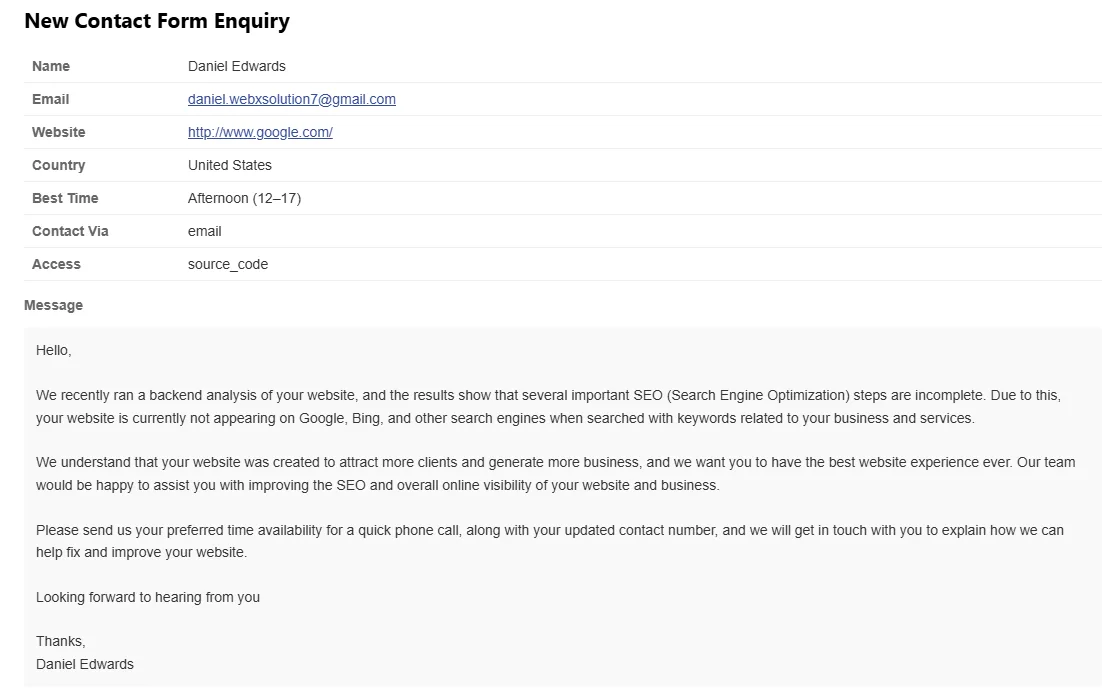
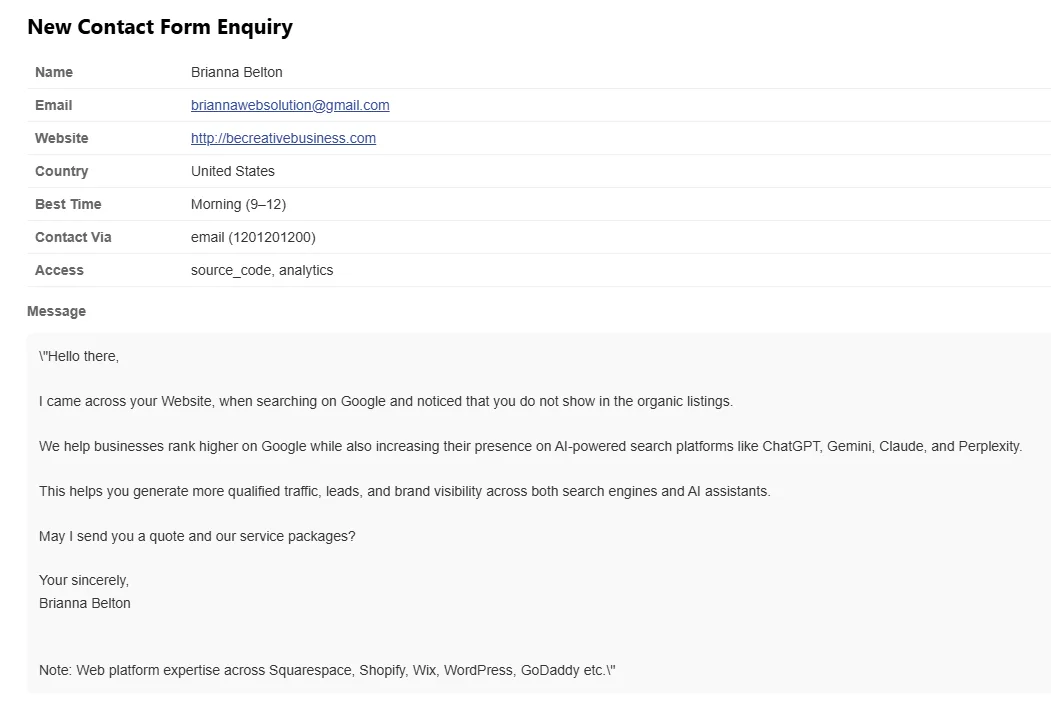
And I’ve already received more than ten emails from people telling me they found serious SEO problems with my website.
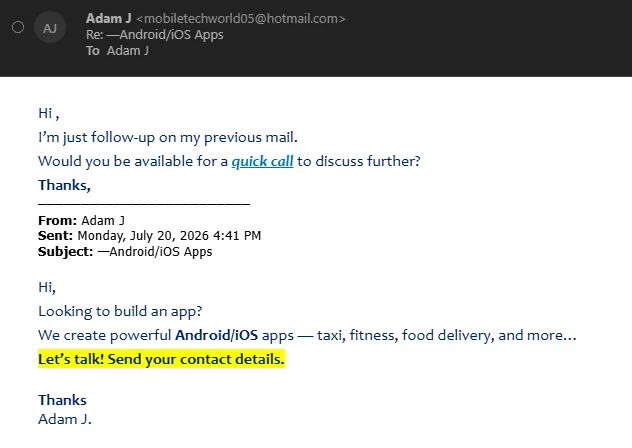
Each one claimed to have analyzed my website and found serious problems. None of them identified anything specific.
Apparently, my brand-new website is already in desperate need of an SEO expert.
The timing is interesting.
Because I know exactly when the website went live. I know what has and hasn’t been implemented. I know the technical stack. I know the current state of the website. And I know that some of the people emailing me haven’t performed the kind of analysis they’re claiming to have performed.
Which raises an interesting question:
How did they find me so quickly?
The answer probably isn’t that someone manually discovered my website, researched my business, analyzed my technical SEO, and decided to reach out. It’s much more likely that my domain entered an automated pipeline.
And that’s where SEO spam gets interesting.
Your Website Is Being Discovered Automatically
The internet is constantly being crawled. Search engines crawl websites. SEO tools crawl websites. Backlink databases crawl websites. Security scanners crawl websites. Domain monitoring services crawl websites. And then there are countless private bots scraping the internet for commercial purposes.
The moment a new domain becomes visible, it can potentially be discovered by automated systems.
That discovery can happen through multiple routes:
- Search engine crawling
- DNS and domain data
- Certificate transparency logs
- Backlink discovery
- Public directories
- Hosting and infrastructure databases
- Social media links
- Sitemap discovery
- Domain monitoring services
A new website doesn’t need to become popular before it becomes visible to automated systems. It just needs to exist.
Once a domain is discovered, it can be processed automatically. The website can be crawled. The technology stack can be fingerprinted. Contact information can be extracted. The business category can be classified. And the domain can be added to a lead database.
At that point, the SEO email isn’t necessarily personal outreach. It’s automation.
How The Spam Pipeline Probably Works
A simplified version of the process looks something like this:
Discover domain
↓
Crawl website
↓
Extract contact information
↓
Identify business category
↓
Generate generic SEO “problems”
↓
Add domain to outreach database
↓
Send automated email
↓
Wait for someone to respond
The important part is that the sender doesn’t necessarily need to understand your website. The system only needs to identify that you own one. Then it can generate a reason to contact you.
That’s why you can launch a website on Monday and start receiving “SEO audit” emails by Thursday. The sender may not have discovered a problem — they discovered an opportunity to sell you a problem.
The Most Important Question: What Did You Actually Analyze?
This is where you can start filtering legitimate outreach from spam.
If someone tells you:
“I found serious SEO issues on your website.”
Ask:
Which ones?
Not “Can you send me your SEO package?” Ask them to identify the actual technical issue.
Which URL has the problem? What HTTP status code did you receive? What is the current canonical URL? Is the page indexable? Is there a noindex directive? What exactly is wrong with the robots.txt file? Which Core Web Vital is failing? Is that based on field data or a synthetic test? Which technical-seo" class="vx-autolink">structured data is invalid? Which pages are duplicated?
The more specific the question, the harder it becomes to fake an answer. A legitimate technical audit should be able to point to something concrete. A spammer usually can’t.
Learn To Separate Claims From Evidence
This is probably one of the most useful skills you can develop as a website owner. Anyone can make a claim.
“Your website is slow.” That’s a claim. Showing you specific performance measurements is evidence.
“Your pages aren’t indexed.” That’s a claim. Showing you the affected URLs and Search Console data is evidence.
“Your website has duplicate content.” That’s a claim. Showing you the URLs involved and explaining the canonical relationship is evidence.
“Your backlinks are toxic.” That’s a claim. Showing you the actual referring domains and explaining why they present a meaningful risk is evidence.
Don’t be impressed by technical vocabulary. Ask for evidence.
You Can Check More Than You Think
You don’t need to become a developer or SEO professional to verify many of the claims being made about your website. Start with Google’s own tools.
Google Search Console
Search Console can provide direct information about your site’s relationship with Google. You can see things like search performance, queries, impressions, clicks, indexed pages, pages that aren’t indexed, sitemap processing, Core Web Vitals, manual actions, and security issues.
If someone emails you saying “Google has penalized your website” — check Search Console. If they say “your website isn’t being indexed” — check Search Console. If they claim “Google can’t find your pages” — look at your indexing reports.
Don’t automatically trust a stranger’s diagnosis when you can verify part of it yourself.
Automated Tools Are Not The Problem
I want to make an important distinction here. Automated SEO tools aren’t bad. They’re incredibly useful. Professional SEO work often involves crawlers, performance testing, analytics platforms, backlink databases, log analysis, Search Console data, and other technical tools.
The problem is what happens after the tool produces the data. An automated crawler might report “342 pages are missing meta descriptions.” Okay. But what does that actually mean? Are those 342 pages important? Are they indexable? Are they product pages? Are they filtered URLs? Are they duplicate pages? Do they receive organic traffic?
The tool found something. That’s useful. But the tool didn’t necessarily tell you whether it matters. That’s where human analysis comes in.
A good technical professional doesn’t just send you a list of everything a crawler found. They tell you: what is wrong? Why does it matter? How important is it? What should be fixed first? What happens if you don’t fix it? That’s the difference between an automated report and an actual analysis.
The Five-Minute Spam Filter
If someone sends you an unsolicited SEO email, here’s a basic filter.
1. Did you ask for the audit?
If not, be cautious. Unsolicited outreach isn’t automatically bad, but the burden of proof is on the person making the claim.
2. Did they identify your actual website?
If the email could have been sent to 100,000 websites without changing anything except the domain name, it’s probably automated.
3. Did they provide evidence?
If they claim your website has problems, ask them to show you.
4. Can you verify the claim?
Check Search Console. Inspect the page. Look at the HTTP response. Check the robots.txt. Check the sitemap. Test the performance.
5. Do they understand the problem?
Ask them why the issue matters. Someone who understands the problem should be able to explain it.
6. Are they promising guaranteed rankings?
That’s a major warning sign. Nobody controls Google’s organic results.
7. Are they trying to create urgency?
“Your website is losing thousands of visitors every day.” “Your competitors are stealing your traffic.” “Google will penalize you.” Fear is one of the easiest ways to sell an unnecessary service.
Here’s The Irony
This is where the story gets personal for me.
I actually sell marketing development myself. That’s part of what I do. I build websites. I work with digital marketing. I work with SEO. I work with the technical side of digital businesses. And now I’m launching my own company in an industry where an enormous spam machine has spent years damaging the reputation of the exact services I’m trying to provide.
That’s the irony. I’m not sitting outside the industry pointing at it. I’m part of it. Which means that when I send a legitimate business a message, I have to compete against every fake SEO audit that has ever landed in their inbox. I have to overcome the distrust created by people who promised impossible rankings. I have to explain that I’m not going to pretend I’ve discovered some secret problem just to sell them a package. I have to prove that I’m actually looking at their business. And I have to do that while an automated spam machine is sending thousands of generic emails every day.
That’s a difficult environment to enter as a legitimate business.
The Real Damage
The biggest problem isn’t that I personally receive ten spam emails in three days. I can delete them.
The real damage happens when a business owner receives those emails for years. Eventually, they start thinking: SEO is bullshit. Marketing agencies are scammers. Everyone just wants my money. And now, when someone who actually knows what they’re doing approaches them, they are already defensive.
That’s the damage. A legitimate company may genuinely need help with its website but refuse to invest because they’ve been burned before. A business owner may have serious technical problems but ignore them because they assume every SEO professional is just another salesperson. And someone who has spent years developing real technical and marketing skills now has to spend half the sales process proving that they’re not part of the machine.
That’s what spam does. It doesn’t just annoy people. It destroys trust.
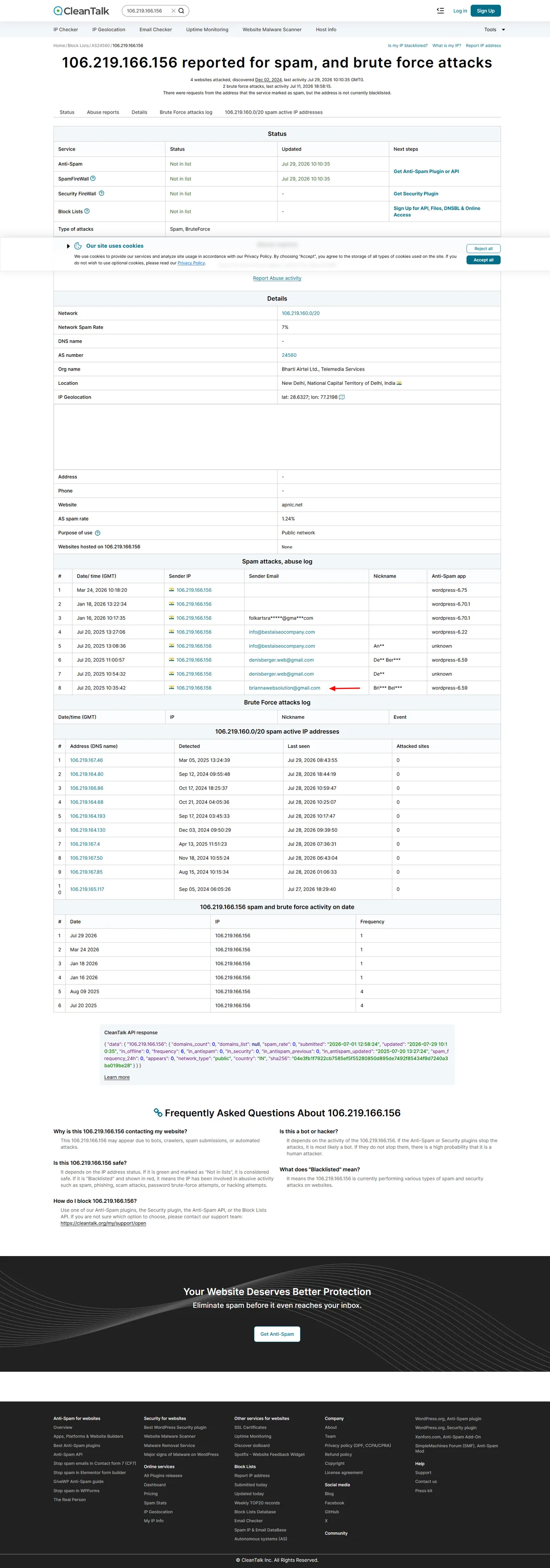
This is where it stops being annoying and starts being dangerous. The same people sending you fake SEO audits may also be probing your website for vulnerabilities. That email isn’t just spam — it’s reconnaissance.
I Don’t Call Myself An SEO Specialist
I’ve never really liked the term. And I definitely don’t believe in the “SEO guru” nonsense.
SEO evolves too quickly. Search engines change. Technology changes. User behaviour changes. AI changes how people discover information. You can’t learn SEO once, put your knowledge on a shelf, and call yourself an expert forever.
The only thing you can really do is stay up to date. Keep learning. Keep testing. Keep questioning. What worked five years ago might not work today. What works today might not work next year. That’s the reality.
I don’t have a secret formula that Google forgot to tell everyone else about. I have experience. I’ve worked across development, websites, marketing, e-commerce, international business, and search. But experience doesn’t mean you stop learning. If anything, the longer you work in technology, the more you realize how much you still don’t know.
The Industry Doesn’t Need More Gurus
It needs more people who actually do the work.
People who are willing to say: “I don’t know yet.” “Let’s investigate.” “That strategy isn’t working. Let’s change it.” “I can’t guarantee number one on Google.” “Your website doesn’t need to be rebuilt. We can fix what’s already there.”
That’s what real expertise looks like to me. Not pretending to know everything. Not making impossible promises. Not creating fear to sell a service. Just understanding the problem, doing the work, and staying current enough to adapt when the world changes.
Because I have to compete in this industry too. And the frustrating part is that I’m not just competing against other legitimate businesses. I’m competing against a massive machine built around making people distrust the entire industry.
So when I get ten spam emails three days after launching my website, I don’t just find it annoying. I find it ironic. Because the same machine that is trying to sell me SEO is also making my job harder when I try to sell legitimate marketing development to someone else.
The industry doesn’t need more spam. It needs more transparency. More evidence. More technical understanding. And fewer people pretending they know everything.
Because SEO isn’t a magic trick. Marketing isn’t a guaranteed result. And nobody has a secret button that makes Google rank your website number one.
The only real advantage anyone has is staying current, doing the work, and being honest about what they actually know.
